
Exchange betting guide
What exchanges to use for lay betting
Choosing a betting exchange is not just about the brand name. The exchange you use affects liquidity, how easily lays are matched, available prices, commission, and how practical your manual lay betting workflow becomes.
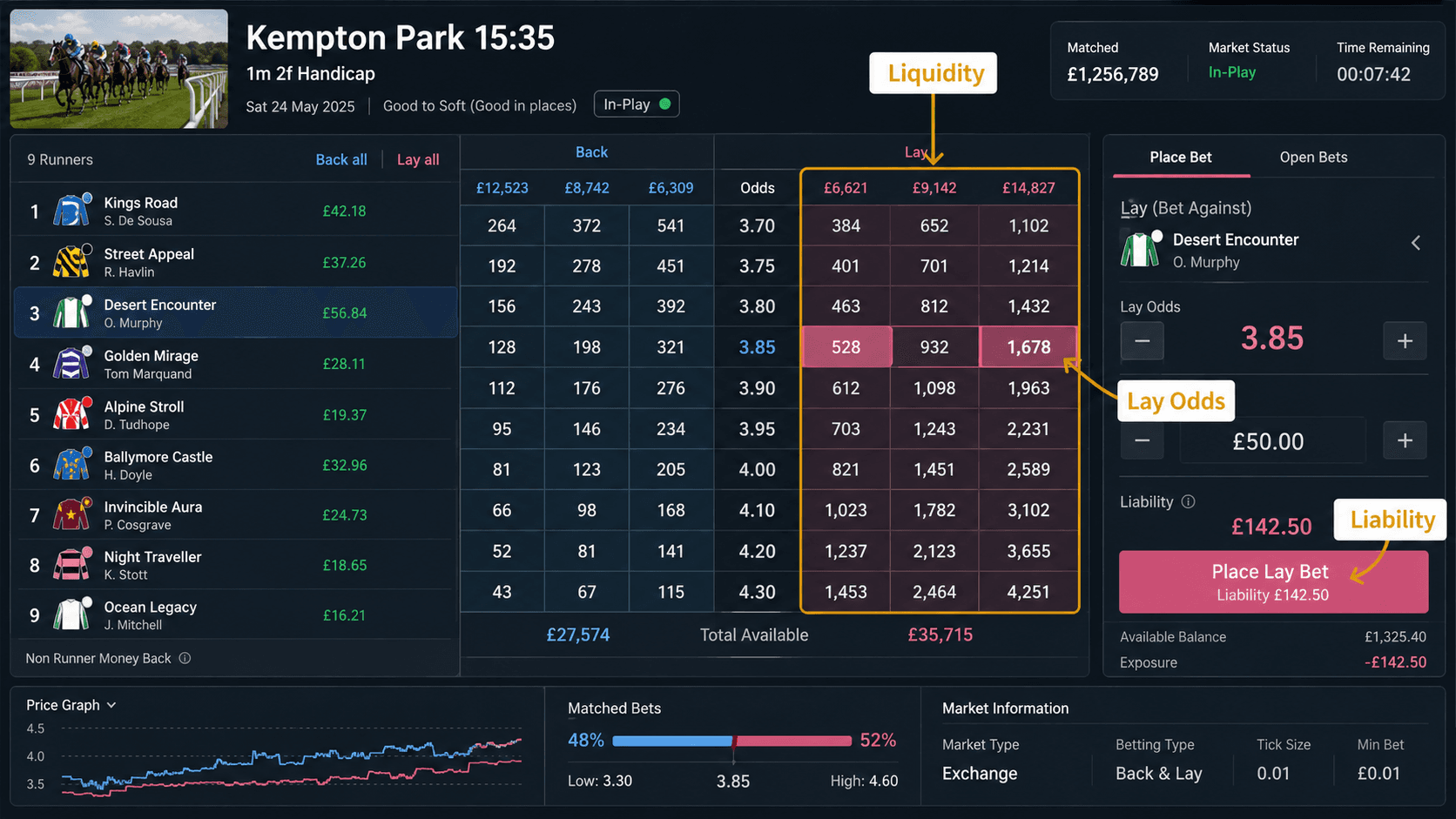
Quick answer
For UK and Irish horse racing lay betting, many users start by comparing Betfair, Smarkets, and Matchbook. The most important factor is usually liquidity: can the lay be matched at a sensible price with acceptable liability?
Lay Picks may use read-only exchange odds for market context, but users make their own manual decisions. Lay Picks does not place bets automatically.
What is a betting exchange?
A betting exchange is different from a traditional bookmaker. With a bookmaker, you are betting against the company. With a betting exchange, you are betting against other users.
That means you can either back a selection to win or lay a selection not to win. When you place a lay bet, you are effectively taking the role of the bookmaker. Someone else backs the horse, team, or outcome, and you accept the other side of that bet.
This is why exchange betting is so useful for lay betting. It gives you more control over the price, the liability, and the type of opportunity you want to take.
For a full beginner-friendly explanation, read our guide to what lay betting is.
Why the exchange you use matters
Not all betting exchanges are equal. The best exchange for lay betting is not always the one with the lowest commission or the cleanest interface. The most important factor is usually liquidity.
Liquidity simply means how much money is available in the market. When an exchange has strong liquidity, it is easier to get your lay matched at a sensible price. When liquidity is weak, your bet may sit unmatched, only partially match, or force you to accept a worse price than planned.
For lay betting, this matters because discipline is everything. If your system says a lay should only be placed below a certain price, you need an exchange where those prices are realistic and available often enough.
A good lay betting exchange should offer:
Betfair: often the first exchange to compare
For many UK racing users, Betfair Exchange is the first exchange to compare because it is widely used and often has strong market depth.
The main reason is liquidity. Deeper markets can make it easier to get matched, easier to read market movement, and easier to use a structured lay betting approach.
This is especially important for anyone placing lays close to the off or using in-play keep-lay prices. If a market has more money available, you have a better chance of getting matched at the price you actually want.
It is still important to check the actual race, price, and available money. A popular exchange does not make a weak lay case stronger, and it does not remove liability.
Smarkets: a strong second choice
Smarkets can be a useful exchange to compare, especially for users who like a clean interface and want another view of the market.
The main appeal of Smarkets is that it can be simple to use and competitive on commission. For some users, the clean interface and pricing can make it attractive. It is also useful as a comparison point when checking whether a lay price looks fair.
The main drawback is liquidity. While Smarkets can be strong in certain markets, it generally does not match Betfair for overall depth, especially when you need consistent matching across many races.
That does not make Smarkets a bad option. It means users should check market depth race by race rather than assuming every exchange will behave the same.
Matchbook: useful, but more niche
Matchbook is another exchange worth checking, particularly if you like comparing prices across different platforms.
It can sometimes offer useful prices and may be worth having available as an extra option. However, for regular lay betting, it is usually more niche than Betfair. The key question is not just whether a price appears on screen, but whether there is enough money available for you to get matched properly.
This is why Matchbook can be useful as a comparison exchange but may not be the best main exchange for every user. If the liquidity is there, it can be useful. If not, Betfair will usually be more practical.
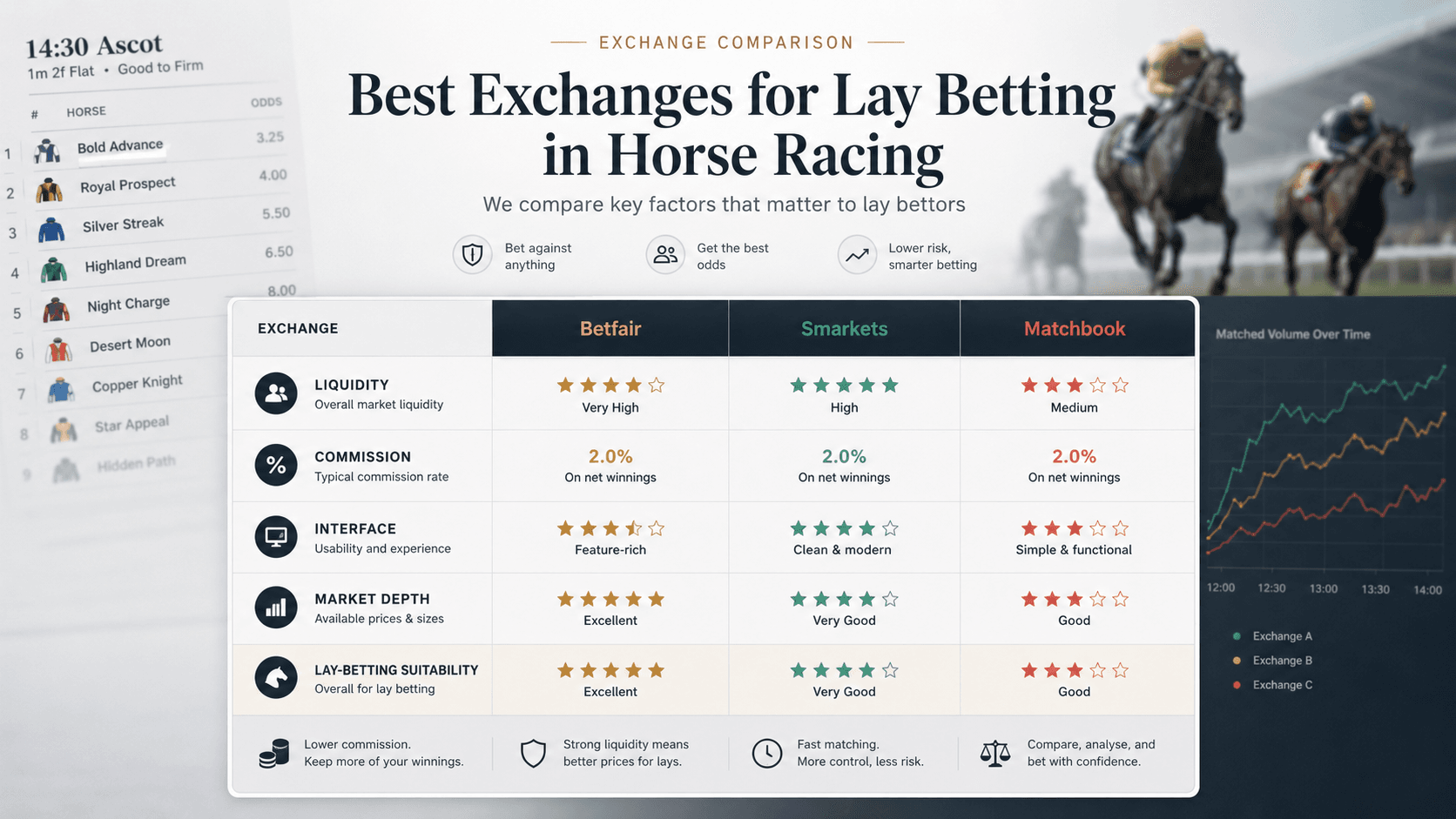
Betfair vs Smarkets vs Matchbook
The simple version is this:
Betfair is often the first place users compare because it is widely used and can have strong racing liquidity.
Smarkets is a close second and can be a strong alternative, especially for users who like a simpler exchange experience.
Matchbook is worth checking, but it is usually better treated as an additional comparison point unless the specific market has enough depth.
For beginners, the most sensible approach is often to start with Betfair, understand how exchange betting works, and then compare prices with Smarkets or Matchbook once you are more confident.
What to check before placing a lay
Before placing any lay bet, it is important to check more than just the odds.
A price might look attractive, but if there is not enough money available, you may not get matched. A horse might look like a good lay, but if the market is moving strongly in its favour, you need to understand why.
Before placing a lay, check:
Lay betting works best when the decision is controlled and repeatable. Guessing, chasing, or forcing bets at poor prices can quickly damage results.
This is one of the reasons Lay Picks focuses on clear reasoning and practical lay opportunities.
Why we keep lay odds under 11.0
At Lay Picks, we usually keep recommended lay odds under 11.0 to help manage liability.
This is an important part of the system. Higher lay odds can create much larger liabilities, even when the stake looks small. For example, laying at short or mid-range prices is much easier to manage than laying high-priced runners where one mistake can create a much larger loss.
Keeping odds under 11.0 helps create a more disciplined structure. It can reduce volatility, keep liability more visible, and make the staking framework easier to understand.
This does not mean every horse under 11.0 is a good lay. The selection still needs to be weak enough overall. The odds rule simply acts as a safety boundary so the system does not drift into unnecessary high-liability bets.
A conservative staking system built for control
Lay Picks is designed around a conservative staking approach.
The aim is not to chase huge wins from risky lays. The aim is to identify sensible lay opportunities, keep liability under control, and use a staking system that can grow naturally with the bank.
The staking system is designed to stay practical. It works alongside manual tracking and recovery-step visibility without encouraging reckless staking.
That matters because every lay betting system will have losing bets. The key is not to pretend losses will not happen. The key is to manage them properly.
A good system should:
This is the kind of structure Lay Picks is built around.
How Lay Picks helps
Lay Picks is being built to make lay betting clearer, more structured, and easier to manage.
Instead of leaving users to jump between racecards, odds screens, ratings, and spreadsheets, the aim is to bring the key information into one clear workflow.
Lay Picks focuses on:
The goal is not to make betting feel complicated. The goal is to make it more controlled.
Exchange/API integrations remain read-only. Lay Picks uses market context to support research, not to place bets.
You can learn more about how Lay Picks works, or read more articles on the Lay Picks blog.
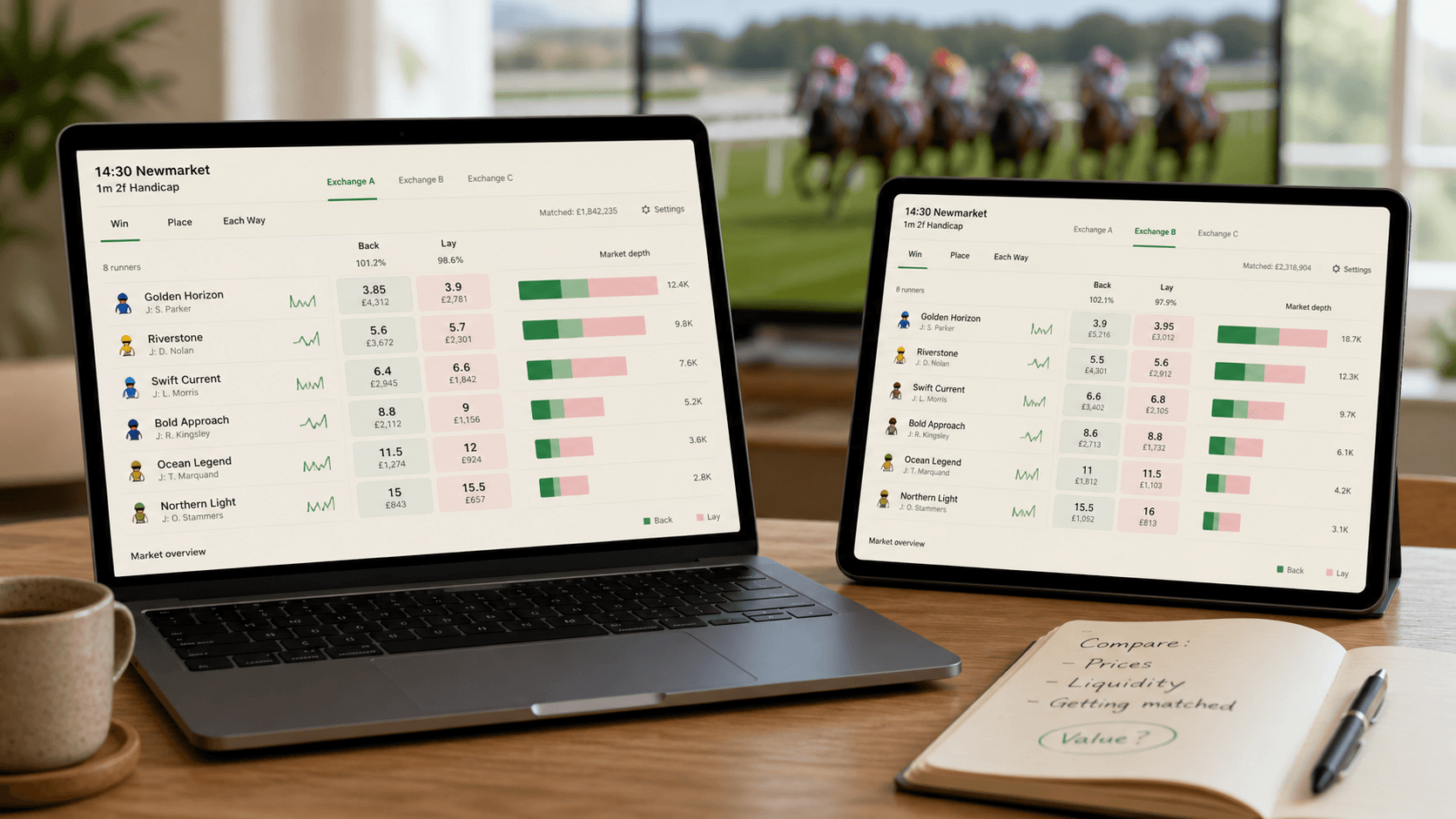
Final thoughts: which exchange should you use?
For many UK and Irish racing users, Betfair is the first exchange to compare because it is widely used and can have strong liquidity.
Smarkets is a very good second choice and can be useful for comparison or as an alternative exchange.
Matchbook is also worth checking, but it is usually more niche and less suitable as the main exchange for most users.
The most important thing is not just choosing an exchange. It is using that exchange with discipline. Check the liquidity, understand the liability, avoid high-risk odds, and use a structured staking system.
That is why Lay Picks usually keeps recommended lay odds under 11.0 and focuses on conservative, practical, research-led lay betting.
Responsible gambling note
Lay betting involves risk. You can lose more than your stake because liability depends on the lay odds. Lay Picks provides research only and does not place bets for users. Please bet responsibly, never chase losses, never bet under pressure, and always understand your full liability before placing a lay bet.
If betting stops feeling controlled, support is available from GambleAware and GamCare.
Leave a comment
Have a question, correction, or suggestion for this exchange guide? Send it to the Lay Picks team and mention the article title so it can be reviewed properly.
Email a commentRead next
Learn why liability is the number to check before using any exchange lay price.
Lay betting liability explained