
Staking guide
How Staking Works
Learn how conservative staking, percentage-based liability, manual tracking, and responsible recovery rules can keep lay betting risk visible.

Quick answer
Conservative lay betting staking starts with liability, not the headline stake. Lay Picks keeps stakes proportional to the current bank, uses lower percentages as lay odds rise, and treats odds above 11.0 as outside the active staking framework.
The Personal Tracker is designed for manual discipline: users can record results, track bank movement, review recovery steps, and plan withdrawals. Lay Picks provides research and tracking support only. It does not place bets automatically.
Staking is one of the most important parts of any lay betting system. Picking the right horse to oppose matters, but how much you risk matters just as much.
Our approach is built around controlled liability, conservative percentages, and clear rules. Instead of placing random stakes or chasing losses emotionally, the staking system is tied to two simple things: the odds of the lay bet and the size of your current bank.
That means the system adjusts naturally as your bank changes. When the bank grows, the stakes compound with it. When the bank is smaller, the stakes stay proportionally controlled. The aim is simple: keep the risk level consistent, disciplined, and easier to manage.
Why Staking Matters
Lay betting is different from normal win betting because the risk is based on liability.
When you lay a horse, you are betting against it winning. If the horse loses, you win the stake. If the horse wins, you pay the liability. The higher the odds, the bigger that liability becomes.
Betfair’s own exchange help explains that laying means taking the other side of a selection and choosing how much you are prepared to risk. That is why the staking conversation has to start with liability, not just the stake shown on screen. You can read the official explanation here: Betfair: what does lay mean?
That is why staking cannot be treated casually. A £10 lay stake at low odds is very different from a £10 lay stake at higher odds. The same stake can create a much larger risk depending on the price.
This is why our system uses percentage-based staking linked to the odds band. Lower odds allow a slightly higher percentage. Higher odds use a much smaller percentage. The result is a calmer, more controlled way to manage exposure.
How Our Conservative Staking System Works
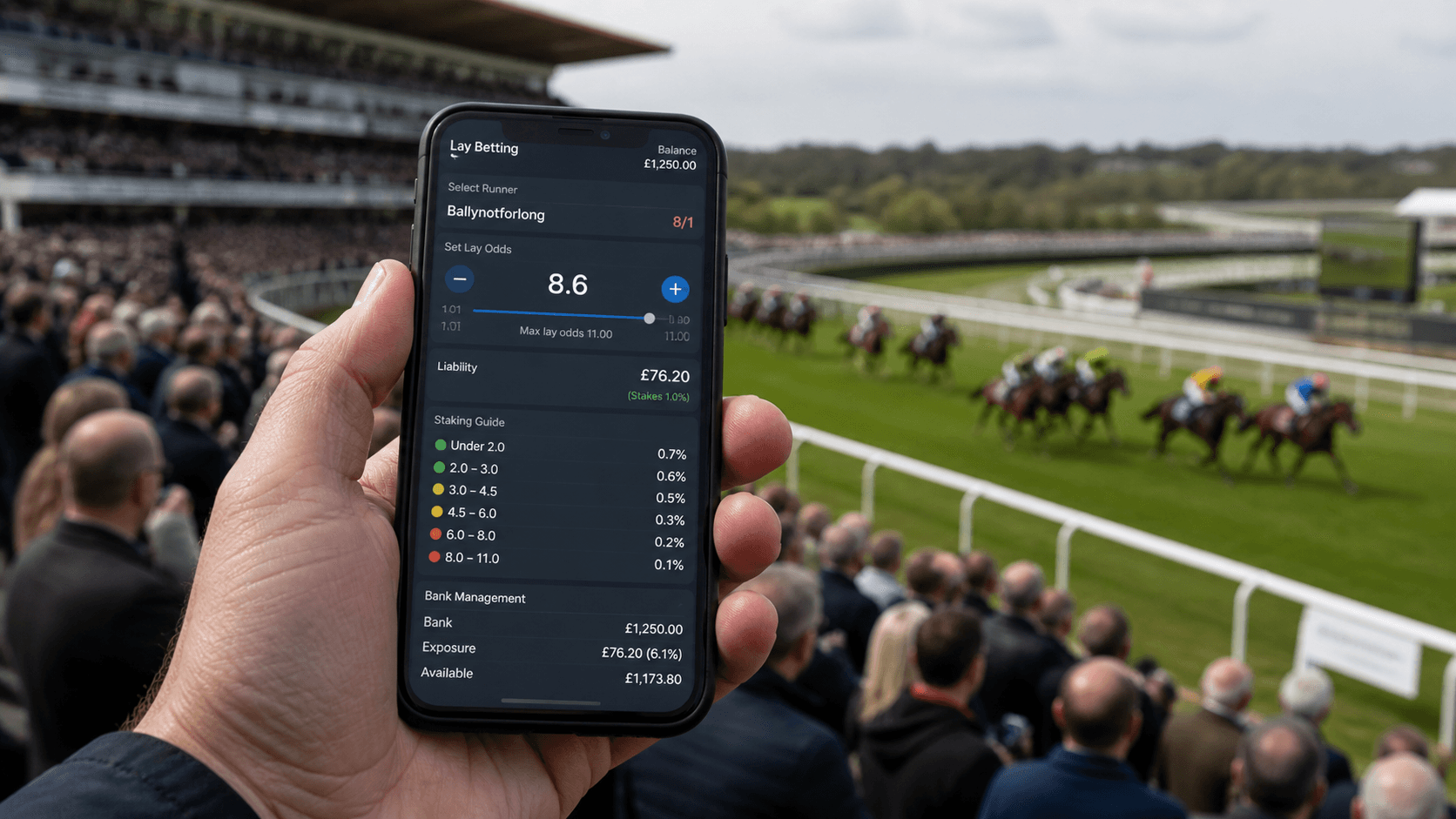
The site uses a conservative active staking scale designed around small percentages, visible liability, and repeatable rules.
The goal is not to be reckless. The goal is to make every bet fit inside a controlled structure. Each lay recommendation sits within an odds band, and each band has its own stake percentage.
This keeps the staking consistent. It also stops higher-priced lays from taking up too much of the bank.
Every stake is calculated from the current bank. If the bank grows, the suggested stake can grow with it. If the bank reduces, the stake reduces too. This keeps the system proportional rather than emotional.
The Active Staking Scale
The active staking scale is based on odds bands. The higher the lay odds, the lower the stake percentage.
| Lay odds band | Stake percentage | Purpose |
|---|---|---|
| Up to 2.0 | 0.70% | Lowest odds band with the highest active percentage |
| 2.1 - 2.8 | 0.60% | Still low liability, controlled active staking |
| 2.9 - 3.5 | 0.50% | Balanced staking for lower-mid odds |
| 3.6 - 4.5 | 0.39% | Reduced percentage as liability increases |
| 4.6 - 5.8 | 0.34% | Conservative mid-range staking |
| 5.9 - 7.0 | 0.28% | Lower exposure for higher lay prices |
| 7.1 - 8.0 | 0.24% | Extra caution as odds rise |
| 8.1 - 9.0 | 0.20% | Reduced risk at higher odds |
| 9.1 - 10.0 | 0.16% | Very conservative exposure |
| 10.1 - 11.0 | 0.12% | Maximum active odds range |
| Above 11.0 | No stake | Invalid / no bet / do not count |
This scale is designed to keep liability manageable. It does not treat every lay bet the same, because every odds range carries a different level of risk.
Why We Keep All Odds Under 11.0
One of the most important rules is that active lay bets stay under 11.0.
This is not a random limit. It is there to keep liability inside a clearer risk framework.
Once lay odds move too high, the liability can become much harder to control. Even a small stake can create a large potential loss. By keeping all active bets at 11.0 or below, the system avoids the most dangerous part of the market.
That does not mean every horse under 11.0 is a bet. It simply means that anything above 11.0 is outside the staking framework and should not be counted as an active play.
The system is built around controlled selections, controlled odds, and controlled liability.
How the Personal Tracker supports discipline
The Personal Tracker is useful because it makes the staking process visible after the research is finished. Users can record the date, time, racecourse, lay odds, result, suggested stake, liability, profit or loss, Betfair bank, total bank, cumulative loss, and next staking step.
That matters because lay betting can feel deceptively simple if you only look at whether the last runner won or lost. A tracker keeps the wider picture in view: current bank, total profit or loss versus the start, weekly profit, planned withdrawals, and what should remain in the bank.
The withdrawal tracker is not a promise of profit. It is an organisational tool for users who want a clear record of what has happened and a calmer way to decide what, if anything, should be moved out after a settled period.
Why psychology matters after a bad run
Psychology is a major part of trading and lay betting. A bad run can make even a sensible user feel rushed, frustrated, or tempted to increase stakes just to get back to where they started.
This is exactly when a staking plan matters most. The purpose of the tracker is not only to calculate numbers. It also gives the user a calm process to follow when emotions are high: record the result, check the bank, review the liability, and only then decide whether the next manual bet still fits the rules.
Staying calm after losses is not about pretending losses do not matter. It is about avoiding impulsive decisions when the risk is clearest. If a bad run starts affecting judgement, the disciplined decision is to pause, reduce activity, or stop for the day.
How the recovery rules add structure
The site also supports recovery rules for users who want a structured response after a difficult run.
The recovery system only activates after two losses in a row. Its role is to keep the next step rule-based, not emotional.
The recovery rules are not about reckless chasing. They are there to provide structure. Instead of reacting emotionally after losses, the system follows a clear process.
That is important because losing runs can happen in any betting system. The key is not to panic. The key is to have rules in place before the losses happen.
Recovery staking does not guarantee that losses will be recovered. It simply gives the user a defined framework to review before deciding whether to continue manually.
Why Percentage-Based Staking Compounds Naturally
Because staking is based on a percentage of the current bank, the system compounds naturally over time.
For example, if the bank grows, the calculated stakes grow with it. If the bank falls, the stakes reduce with it. This means the staking remains linked to the actual size of the bank at all times.
This is very different from using fixed stakes forever. Fixed staking can become too aggressive when the bank is smaller, or too slow when the bank grows.
Percentage-based staking keeps the risk level more consistent. It allows the system to scale naturally without needing constant manual changes.
Why This Approach Matters
The strength of the system comes from combining several layers of protection:
Together, these rules create a more controlled and sustainable approach. The aim is not to make staking complicated. The aim is to make it clear, structured, and easier to follow.
That is why this site is built around more than finding lay picks. It is also built around showing liability, tracking outcomes, and helping users decide when a race should simply be skipped.

Using this with Lay Picks research
Staking should come after the research, not before it. A sensible stake does not make a weak lay case stronger. The runner still needs a clear vulnerability case, current exchange odds, and no obvious protection cluster.
For the wider workflow, read how Lay Picks works, the guide to lay betting tips, and the explanation of what lay betting means.
Responsible gambling note
Lay betting involves risk. You can lose more than your stake because liability depends on the lay odds. Lay Picks provides research and tracking support only and does not place bets for users. Please bet responsibly, never chase losses, and only bet with money you can afford to lose.
If betting stops feeling controlled, support is available from organisations such as GambleAware and GamCare.
Leave a comment
Have a question, correction, or suggestion for this staking guide? Send it to the Lay Picks team and mention the article title so it can be reviewed properly.
Email a commentRead next
Learn how liability works before using any manual staking plan.
Lay betting liability explained